Robohub.org
 

The award-winning Smart Trash Can moves autonomously to catch your trash

by
15 February 2013


share this:
13-0013-r

This Smart Trash Can, developed by Minoru Kurata, an engineer at a Japanese auto maker, won an Excellence Award at the Japan Media Arts Festival.

“When you toss trash at it, a sensor detects the position of the trash, and sends the information to a PC. The PC calculates where the trash will fall, and communicates it to the can via wireless connection.”

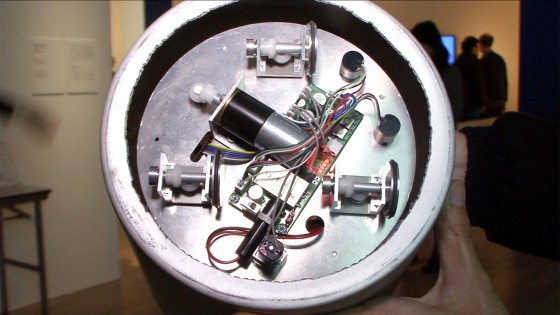
“The trash can has to move autonomously. To achieve that, I created a special mechanism, with a single axis for both the wheel rotation and the change in angle. So even if the wheels rotate, the position of the can itself doesn’t change. That mechanism, the circuitry, and the motor controller all fit within the diameter of the can. If the center of gravity is high, the can will fall over, so I made the can low, narrow, and compact, to keep the center of gravity as low as possible.”

“I’ve received inquiries about turning this into a commercial product. Right now, I’m working to patent the technology for the Smart Trash Can.”

“The probability that the trash will go in is not very high, only 10-20%. Even making full use of the current sensor, it still has errors. So I’d like to improve the success rate. I want to either improve the sensor, or upgrade the control by reducing the error through a program.”


tags: ,


DigInfo TV is a Tokyo-based online video news platform dedicated to producing original coverage of cutting edge technology, research and products from Japan.

            AUAI is supported by:


Subscribe to Robohub newsletter on substack


Related posts :

How green is your robot? And other awkward questions

Robots clean rivers and sort waste, monitor ecosystems, and inspect renewable-energy infrastructure. But even the greenest robot has an environmental footprint.

These tiny drones are powered by sound

  24 Aug 2026
EPFL engineers have designed acoustic cavities that convert sound waves into thrust, propelling small robots and ultralight aerial vehicles without on-board actuators or electronics.

#AAMAS2026 blue sky award winner: Foundation world models for agents in changing environments

and   21 Aug 2026
Hear from the AAMAS 2026 Best Blue Sky Paper Award winner.

Robotics roadmaps from around the world spotlight of the month: Japan

Robots have been a prolific theme in Japanese pop culture and media since the 1950s

Intermittent swimming promotes the energy efficiency of fish-like robot movements

How zebrafish-inspired robots save energy by swimming in bursts.

What does it take for a robot to hold a conversation with a room, not just a person?

and   14 Aug 2026
Find out about a summer school held at Imperial College London.

Robotics roadmaps from around the world

We embark on a tour into some of the recent and prominent robotics roadmaps from around the world.

A ‘5-in-1’ seed-sized surgical robot

Mini robot can move, cut tissue, release drugs, grip and store samples, and generate heat wirelessly


AUAI is supported by:


Subscribe to Robohub newsletter on substack


©2026.05 - Association for the Understanding of Artificial Intelligence